Article
Kaalratri in Sharad Navratri 2026: The Dark Goddess Who Conquers Fear and Time
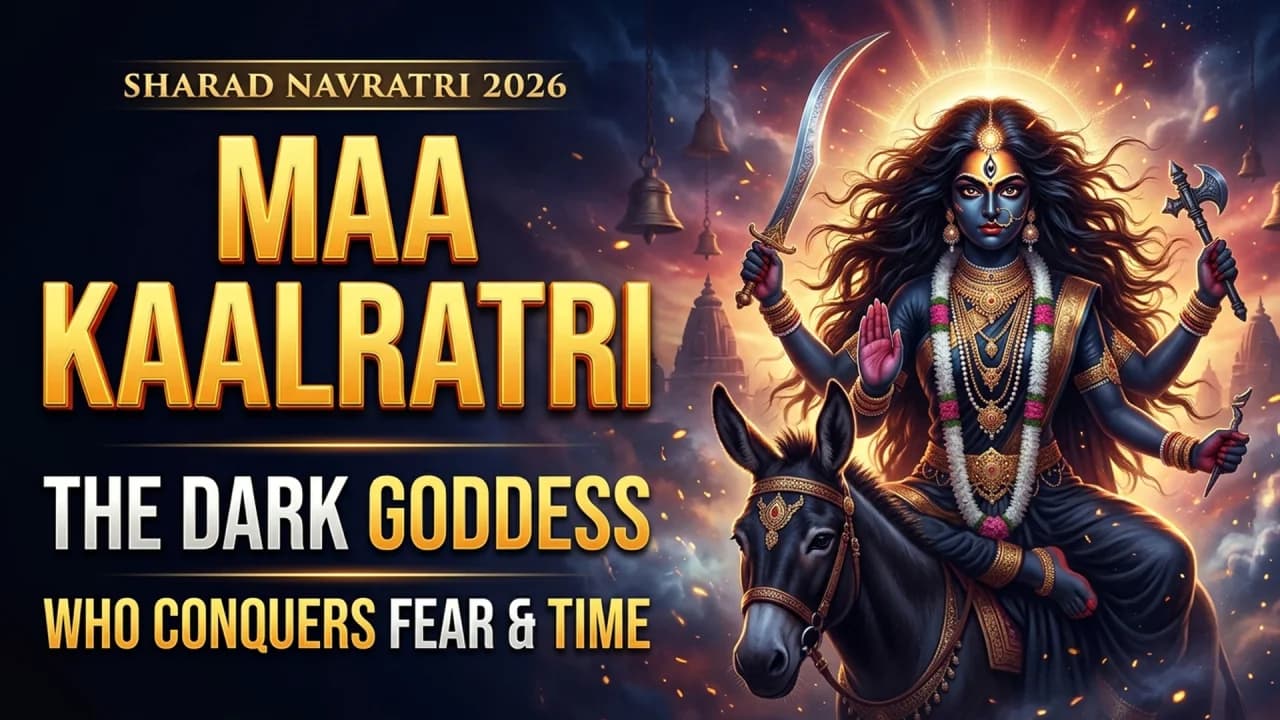
Maa Kaalratri, the seventh form of Goddess Durga, is worshipped during Sharad Navratri for courage, protection, and the removal of fear. Discover her powerful story, the significance of her fierce form, the tale of Raktabeej, and her divine identity as Shubhkari in Navratri 2026.
What comes to your mind when you hear the word darkness? For many people, it means fear, danger, or something unknown. But in Hindu mythology, darkness can have a much deeper meaning. It can represent strength, transformation, and the power to destroy evil.
This is where Maa Kaalratri, the seventh form of Goddess Durga worshipped during Sharad Navratri, comes into the picture. Her appearance is fierce, her energy is powerful, and her stories remind devotees that even the darkest situations can be faced with courage.
Maa Kaalratri is not just a goddess who destroys demons. Her story also carries lessons about controlling our desires, standing against injustice, and finding strength when life becomes difficult.
But why does this goddess, who looks so fearsome, also have the name Shubhkari, meaning the one who brings auspiciousness? To understand this, we need to look beyond her appearance.
What Does the Name Maa Kaalratri Mean?
The name Kaalratri comes from two Sanskrit words: Kaal and Ratri.
Kaal can mean time or death, while Ratri means night. Together, the name is often understood as the dark night associated with time, destruction, and transformation.
Maa Kaalratri is the seventh form of Goddess Durga worshipped during the nine days of Navratri. She is traditionally depicted with a dark complexion, dishevelled hair, three eyes, and flames or radiant energy surrounding her.
At first glance, her appearance may seem frightening. However, devotees believe that her fierce form exists to protect the innocent and destroy negative forces.
This is also why she is called Shubhkari, the one who brings auspiciousness. Her frightening appearance does not mean that she brings harm to her devotees. Instead, it represents her power to confront evil and remove fear.
Her story gives us an important reminder: sometimes, the strongest form of protection does not look gentle, but its purpose is to keep us safe.
Why Is Maa Kaalratri Worshipped on the Seventh Day of Navratri?
During Sharad Navratri, devotees worship nine forms of Goddess Durga over nine days. Each form represents a different aspect of divine feminine energy.
Maa Kaalratri is worshipped on the seventh day, known as Saptami. Devotees pray to her for courage, protection, and strength to face difficulties.
In 2026, the seventh day of Sharad Navratri is associated with Saturday, October 17. However, Saptami tithi continues into Sunday morning, October 18, according to the calendar details provided for Delhi. Since Hindu festival observances depend on tithi timings and local traditions, devotees should check their local Panchang for the exact puja schedule.
The overlap between lunar dates and calendar dates can sometimes make festival calculations confusing. A Hindu lunar tithi does not always begin and end at midnight, which is why a single tithi can span parts of two civil dates.
Maa Kaalratri's worship is also associated with the idea of facing the unknown without allowing fear to control our actions.
The Battle Against Raktabeej: When Desires Keep Growing
One of the most powerful stories associated with the Goddess is her battle against Raktabeej, a formidable demon whose name means something like “blood seed.”
According to the traditional story, Raktabeej possessed a special power: every drop of his blood that fell to the ground created another demon just like him.
Imagine fighting an enemy only to discover that every injury makes the enemy stronger. That was the challenge faced by the Goddess and the divine forces fighting alongside her.
As the battle continued, the number of demons kept increasing. Ordinary attacks could not easily defeat Raktabeej because every drop of blood risked creating another version of him.
Maa Kaalratri, in her fierce form, helped bring the battle to an end by preventing his blood from falling to the ground. In popular tellings of the story, the Goddess drank or absorbed his blood before it could create more demons.
This finally stopped Raktabeej's extraordinary power.
But the story can also be understood as a lesson about human behaviour.
Think about anger, jealousy, greed, or uncontrolled desire. Sometimes, when we react to these feelings without thinking, the problem becomes even bigger. One angry response leads to another, and a small disagreement turns into a major conflict.
Raktabeej can therefore be interpreted as a symbol of problems that multiply when they are not handled wisely.
The message is simple: sometimes, we need to stop a problem at its source instead of allowing it to grow.
What Do Maa Kaalratri's Four Hands Symbolise?
Maa Kaalratri is commonly depicted with four hands, each carrying a symbolic meaning.
Her upper left hand holds a vajra, or thunderbolt weapon, while her lower left hand holds a sword. These weapons represent her power to fight destructive forces and protect righteousness.
Her right hands are traditionally shown in the Varada Mudra and Abhaya Mudra.
The Varada Mudra is a gesture associated with blessings and generosity. The Abhaya Mudra represents fearlessness and reassurance, reminding devotees that they can seek divine protection without giving in to fear.
She is also commonly shown riding a donkey, which is her traditional vehicle. Her three eyes symbolise extraordinary awareness and divine power, while her dark complexion and fierce appearance distinguish her from the other forms of Durga.
Together, these features represent two important sides of the Goddess: the power to confront evil and the compassion to bless her devotees.
Her weapons are not simply symbols of destruction. In the context of the story, they represent the strength needed to protect what is right.
The Connection Between Maa Kaalratri and Mahakaal
The name Kaalratri is also associated with the idea of time and its power over all living beings.
In Hindu spiritual traditions, Mahakaal is a name associated with Lord Shiva in his form as the Lord of Time. Some depictions of fierce forms of the Goddess show her standing over Shiva, symbolising profound ideas about divine energy, time, and cosmic power.
These images can have different interpretations across Hindu traditions. They are not meant to be understood only as scenes of physical conflict.
Instead, they can remind devotees that life is constantly changing. Nothing in the material world remains exactly the same forever. Time brings beginnings, endings, growth, and transformation.
Maa Kaalratri represents the power to face these changes without being defeated by fear.
Her story encourages us to understand that courage does not mean that we never feel afraid. It means that we continue to do what is right even when a situation feels difficult or uncertain.
What Can We Learn From Maa Kaalratri Today?
The stories of Maa Kaalratri may come from ancient Hindu mythology, but their lessons can still connect with everyday life.
Students may face exam pressure. Young professionals may worry about their careers. Families may deal with disagreements, financial stress, or uncertainty about the future.
In such moments, fear can make even a manageable problem seem impossible.
Maa Kaalratri's story encourages devotees to face challenges instead of running away from them. Her battle against Raktabeej also reminds us to recognise harmful patterns before they grow stronger.
Another important lesson is the need to stand against injustice. The Goddess uses her power to protect righteousness, showing that strength should be used responsibly rather than to frighten or control others.
Her worship also reminds devotees to respect women and recognise the strength of feminine energy. Her fierce appearance challenges the idea that power must always look soft or gentle.
Sometimes, strength means setting boundaries. Sometimes, it means speaking up. And sometimes, it means staying calm enough to make a thoughtful decision instead of reacting in anger.
The Deeper Meaning of the Dark Goddess
Maa Kaalratri teaches us that darkness is not always something to fear. It can also represent the unknown parts of life that we need the courage to understand.
Her fierce form reminds devotees that evil must be confronted, destructive desires must be controlled, and fear should not decide the direction of our lives.
As Sharad Navratri 2026 brings devotees together in prayer, the worship of Maa Kaalratri offers a powerful message: even when life feels uncertain, courage and faith can help us move forward.
The Goddess may be known for her dark appearance, but her name Shubhkari carries a message of hope and auspiciousness.
Perhaps that is the most meaningful lesson of all. We do not always find strength when everything around us is bright and peaceful. Sometimes, we discover it when we finally decide to face the darkness.