Blog
Navratri 2026: Why Maa Durga’s Golden Idol Stays in a Bank Locker for 360 Days
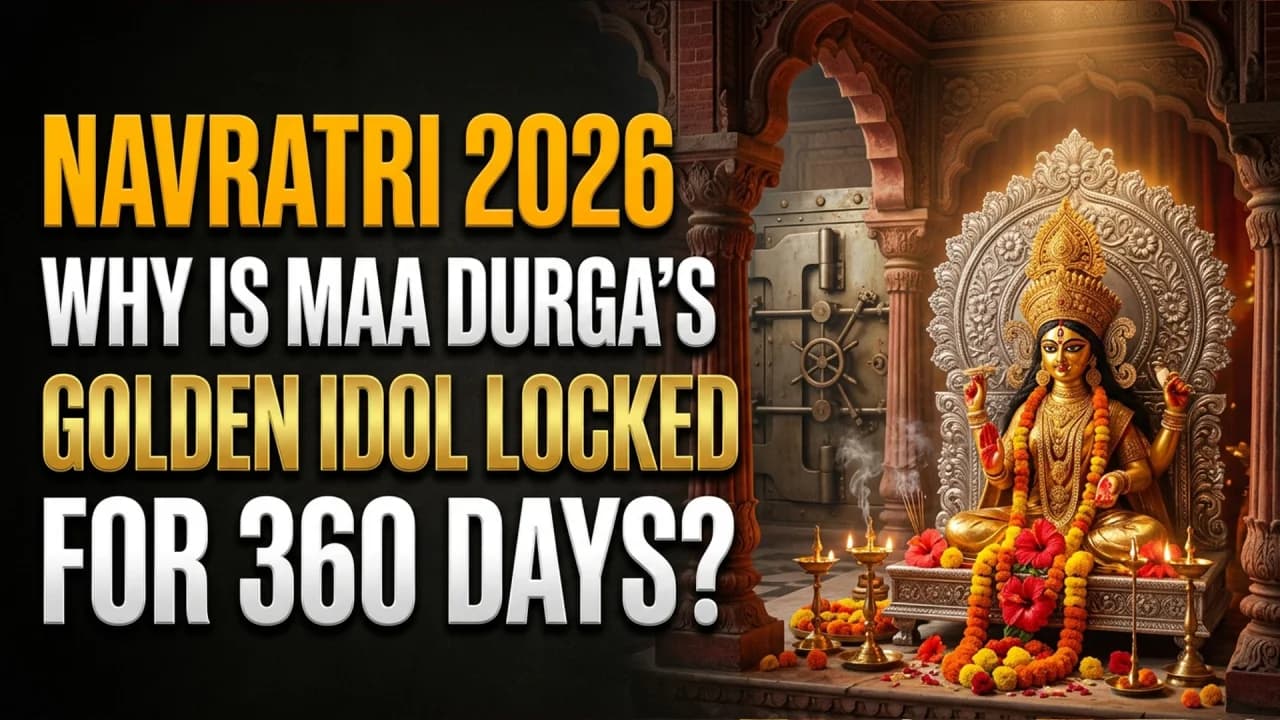
Discover the unique Durga Puja tradition of Jaipur Rajbari in West Bengal, where Maa Durga’s golden idol stays in a bank locker for nearly 360 days. Explore the fascinating story behind this 400-year-old royal tradition, the idol’s history, and the special police security arrangements during Shardiya Navratri 2026.
Imagine a golden idol of Maa Durga that people can see only during the days of Durga Puja, while it remains safely locked inside a bank vault for almost the entire year. It may sound unusual, but this is a tradition followed at Jaipur Rajbari in West Bengal’s Purulia district.
As Shardiya Navratri 2026 approaches, this nearly 400-year-old Durga Puja tradition is once again drawing attention. The royal family’s celebration is famous for its golden idol of Maa Durga, its silver backdrop, and the special security arrangements made every year.
For devotees, the festival is a time to seek the blessings of Maa Durga. For history lovers and tourists, it is also an opportunity to discover a fascinating tradition that has continued across generations. But why is the idol kept inside a bank locker for most of the year? The story behind this practice makes Jaipur Rajbari’s Durga Puja truly unique.
A Golden Idol That Comes Out Only During Durga Puja
Jaipur Rajbari, located in Purulia district of West Bengal, is known for its distinctive Durga Puja celebrations. Unlike many places where the goddess’s idol remains in a temple or puja area throughout the year, the golden idol here is kept in a bank locker for approximately 360 days.
The idol is brought out on the sixth day of Durga Puja, known as Maha Shashthi. It is then taken to Jaipur Rajbari under tight police security, with special arrangements made to protect this valuable religious treasure.
The idol remains at the Rajbari for the festival. After the celebrations are completed on Dashami, it is taken back to the bank locker under police protection.
This careful process has become an important part of the tradition. It also adds to the curiosity surrounding the royal family's Durga Puja, attracting devotees and visitors from Purulia, other parts of West Bengal, and neighbouring states.
What Makes the Durga Idol So Special?
The biggest attraction of Jaipur Rajbari’s Durga Puja is the golden idol of Maa Durga, accompanied by a beautifully crafted silver chalchitra. A chalchitra is a decorative background placed behind the deity in traditional Bengali worship.
Another distinctive feature is the idol’s two-armed form, known as a Dwibhuj form. This makes it different from the more familiar depictions of Maa Durga with multiple arms.
The use of gold and silver, combined with the idol’s traditional design, gives the shrine a special place in the region’s religious and cultural history.
During Durga Puja, visitors come to see the idol and experience the atmosphere of the historic Rajbari. For many devotees, the occasion is not simply about viewing a valuable object. It is also about participating in a tradition that has been preserved by generations of the royal family.
The Nearly 400-Year-Old History of Jaipur Rajbari’s Durga Puja
According to accounts shared by the royal family, the Durga Puja at Jaipur Rajbari dates back approximately 400 years. The tradition is associated with the region’s royal heritage and is believed to have developed during the time of Raja Jai Singh.
In its earlier years, the goddess was worshipped using a traditional clay idol. Over time, however, an incident changed the course of the celebration.
According to the family’s account, a fire broke out in the temple during the period associated with Raja Kashinath Singh. Following this incident, the king resolved to establish a golden idol of Maa Durga.
A family tradition says that the king received a dream in which Maa Durga indicated that a golden idol should be installed. Inspired by this belief, the royal family decided to arrange for a new idol to be made.
Artisans from Varanasi were reportedly invited to create the golden idol and its silver chalchitra. Gold and silver from the royal treasury were used for this special work.
Over the years, the golden idol became the central attraction of the celebration. The story of its creation is still remembered as an important part of the Rajbari’s religious heritage.
Why Is Maa Durga’s Golden Idol Kept in a Bank Locker?
The answer lies in an incident that led the royal family to rethink the idol’s security.
According to accounts of the tradition, a theft took place at Jaipur Rajbari. Thieves reportedly entered the premises and escaped with valuable belongings and jewellery.
Following this incident, the family reviewed how the golden idol could be protected. On police advice, it was decided that the idol would be kept in a bank locker except during the Durga Puja celebrations.
Since then, the practice of bringing the idol to the Rajbari for the festival and returning it to the bank after Dashami has continued.
Today, police security plays an important role in the process. Special arrangements are made when the idol is transported, helping protect an object that holds both religious significance and considerable material value.
This unusual arrangement is one of the main reasons Jaipur Rajbari’s Durga Puja stands out among the region’s traditional celebrations.
How Was Durga Puja Celebrated in the Past?
The celebrations at Jaipur Rajbari were once known for their grand royal atmosphere. According to Runi Banerjee, who is associated with the Rajbari’s traditions, the festival was organised on a much larger scale in earlier times.
The Rajbari reportedly witnessed the presence of elephants, horses, and large gatherings of people during the celebrations. The festival reflected the grandeur and customs associated with the royal household.
However, after the theft, security became a major priority. The arrangements surrounding the golden idol changed, and police supervision became an essential part of the festival.
Despite these changes, the tradition has continued to attract visitors. Devotees still travel to Jaipur to offer prayers to Maa Durga and witness the rare golden idol during the festival.
Royal family member Prashant Narayan Singh Deo has also described the celebration as a tradition that has continued through several generations.
According to accounts shared by the family, the puja traditionally lasted four days, while preparations for a five-day celebration have also been discussed. Visitors should check local announcements for the confirmed programme and timings for 2026.
Jaipur Rajbari Durga Puja: A Tradition Beyond Gold and Silver
The golden idol may be the most talked-about feature of Jaipur Rajbari’s Durga Puja, but the festival’s importance goes beyond its precious materials.
It reflects the connection between faith, family history, traditional craftsmanship, and community celebrations. The royal family’s decision to preserve the idol while maintaining the annual worship shows how a religious tradition can adapt to changing security needs without losing its central place in local culture.
During Shardiya Navratri and Durga Puja, devotees across India worship Maa Durga and celebrate her victory over evil. At Jaipur Rajbari, that devotion takes a distinctive form: a golden idol that leaves its secure bank locker for a few special days each year.
For visitors, the festival offers a chance to see an unusual religious tradition and learn about the history behind it. For the people connected to the Rajbari, it represents a legacy that has survived for generations.